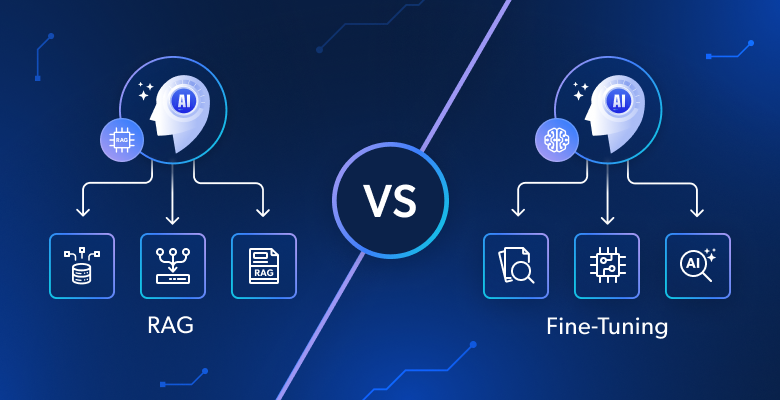
When an enterprise team decides to build an AI application that uses their internal data - a document Q&A tool, a customer service assistant, an internal knowledge base - they face an early architectural decision: should we fine-tune a model on our data, or use retrieval-augmented generation (RAG) to provide that data at query time?
Both approaches have legitimate use cases. But in the enterprise context, RAG almost always wins on the dimensions that matter most: deployment speed, maintainability, cost, and data freshness. Here is what each approach does and how to decide.
How RAG Works
Retrieval-Augmented Generation (RAG) is an architecture that combines a large language model (LLM) with a retrieval system. When a user asks a question, the system first searches a knowledge base (a vector database, document store, or search index) for relevant content, then passes that content along with the original question to the LLM as context. The model generates its answer based on both its training and the retrieved documents.
The key property of RAG is that knowledge lives outside the model. Updating the knowledge base - adding new documents, removing outdated ones, refreshing data - does not require retraining or redeploying the model. The knowledge layer and the reasoning layer are independent.
Quantus IT designs and implements RAG pipelines for enterprise clients across financial services, manufacturing, and technology sectors. The architecture is well-established, Azure-native, and deployable within weeks rather than months.
How Fine-Tuning Works
Fine-tuning involves taking a pre-trained model and continuing its training on a domain-specific dataset. The model's weights are updated so it better reflects the patterns, vocabulary, and style present in the training data. After fine-tuning, the model performs better on tasks similar to what it was trained on - it may generate content in your company's tone, correctly use industry jargon, or reliably output in a required format.
The limitation is that fine-tuning bakes knowledge into the model at a point in time. When your data changes - pricing updates, new policies, revised procedures - the model does not know unless you retrain it. Retraining is expensive, time-consuming, and requires careful management of training data, evaluation sets, and model versioning.
When RAG Outperforms Fine-Tuning
RAG is typically the better choice when:
- The knowledge base changes frequently - product catalogs, policy documents, support articles, pricing
- You need the AI to cite specific sources so users can verify answers
- The use case is factual Q&A over internal documents (not generation of stylistically consistent content)
- You need to deploy quickly - RAG can be production-ready in weeks; fine-tuning projects take months
- Budget constraints apply - RAG uses inference-time compute; fine-tuning requires dedicated training compute
- Auditability matters - RAG retrieves explicit passages that can be logged and reviewed
When Fine-Tuning Is the Right Call
Fine-tuning has genuine advantages in specific scenarios:
- The use case requires consistent output format - structured JSON, specific report templates, domain-specific code patterns
- The model needs to internalize tone, vocabulary, or style at a level that prompt engineering cannot achieve reliably
- Latency is critical and context windows are too large for real-time RAG retrieval
- The training data is stable - for example, a legal or medical domain where standards change infrequently
In practice, the most powerful enterprise AI systems combine both approaches: a fine-tuned model for consistent output behavior, augmented with RAG for factual accuracy and knowledge freshness. But that combination is expensive to build and operate. Most organizations should start with RAG and add fine-tuning only when specific limitations become evident at scale.
Getting the Architecture Right from the Start
The cost of choosing the wrong architecture is not just technical - it is organizational. A fine-tuning project that takes six months to show results delays time-to-value. A RAG pipeline that is poorly chunked or poorly indexed produces confident-sounding answers that are factually wrong, eroding trust in AI tools enterprise-wide.
Quantus IT's AI-Powered Solutions practice specializes in designing AI architectures that match the use case, the data environment, and the operational constraints of enterprise clients. If your team is evaluating options for an internal AI application, contact us to discuss the right approach for your specific context.